


Techni’Sens’ solutions
Preference mapping
Why do some products spark immediate interest, while others leave people indifferent?
You’ve probably asked yourself this question before. And for good reason: consumer preferences play a central role in purchasing decisions—far more than we sometimes realize.

Research in sensory science converges on a key point. When it comes to food products, Research in sensory science converges on a key point. When it comes to food products, hedonic pleasure, the famous “like/dislike”, plays a significant role in the final choice. Price, brand, or context of use act more as levers for adjusting purchase intent, but the sensory experience confirms the consumer’s appreciation of the product.
Of course, these balances are never set in stone. While sensory pleasure often takes precedence in the food sector, the relative importance of various criteria varies depending on the specific context under study. In In cosmetics or pet food,for example, other factors come into play, such as perceived effectiveness, trust, or the context of use. In other words, there is no one-size-fits-all model: each category has its own logic of preference, which must be thoroughly understood.
For over 18 years, Techni’Sens has drawn on its expertise in sensory analysis and consumer testing to unravel these mechanisms. The goal: to gain a detailed understanding of what tips the scales.
What is preference mapping?
Preference mapping aims to answer a simple yet highly strategic question: what makes a product appealing… or not? The goal behind this approach is clear. Above all, the objective is to accurately describe a product universe and then link that description to levels of preference.
Here, we are referring to preference in the organoleptic sense.. In other words, we deliberately set aside price, brand, image, and marketing positioning. Why? Because immediate appeal stems first and foremost from first impressions.. As you know, a product is tasted, smelled, looked at, and touched… before it’s compared.
In practical terms, mapping is based on a fundamental principle:
- consumer preference data (Like/Dislike);
- combined with sensory and physicochemical data.

It is this cross-referencing that allows us to organize the results and identify areas of preference and rejection. There is no magic formula, but it is a rigorous method.
Differences from other marketing approaches
At first glance, one might think that preference mapping is similar to a traditional quantitative study. And yet… the logic is different. Completely different.
Traditional consumer surveys allow us to measure a level of satisfaction: a rating, a review, or an intention to purchase. This is useful, of course. But it’s often limited when we try to understand exactly what makes a product appealing.
Preference mapping works differently. It doesn’t just measure a preference. it relates it to the sensory characteristics of the products. Taste, texture, aroma, appearance… every aspect is analyzed to understand its role in how the product is perceived. That’s what makes all the difference.

As you know:
Two products may receive similar scores, but for very different reasons. And that is precisely what this approach brings to light.
In practical terms, mapping relies on cross-referencing:
- consumer ratings (Like / Dislike);
- and the resulting sensory attributes.
So we’re not talking here about consumer segmentation. Rather, we’re talking about a product analysis tool that allows us to visualize their respective market positions, identify areas of preference, and better understand the factors driving customer loyalty—going beyond mere self-reported data.
Why mapping preferences is essential in marketing
Today, the market is saturated. Too many products. Too many messages. Too many solicitations.
The result? Standing out has become a real challenge. And yet, one thing remains clear: It is always consumer preferences that make the difference. Not promises. Not intentions. How it feels. Period.
But keep in mind that its usefulness isn’t limited to marketing. Far from it.
This approach permeates several aspects of the company:

For R&D teams:
Understand what makes a product appealing or unappealing from an organoleptic perspective, optimize formulations, identify gaps between rejection and preference, and pinpoint genuine opportunities for innovation.

For marketing teams:
Position a product based on regional preferences, but also in relation to competitors; highlight its sensory strengths; segment consumers by perception profiles; optimize the product portfolio; and prioritize investments where the impact will be greatest.

For quality teams:
Monitor sensory consistency over time, compare batches or product lines, and assess the impact of changes in ingredients or processes on acceptability.
How does a preference mapping process work?
Key stages of a project
Phase 1: data collection
It all starts with field research: consumer surveys and product testing. The goal is clear: to gather consumer feedback (Like/Dislike) from a robust sample of at least 100 respondents and at least 8 products—ideally more if detailed segmentation is required.
Phase 2: development of sensory profiles
At the same time, the products are described using sensory and physicochemical data. This yields precise profiles that are comparable and actionable.
Phase 3: Preference mapping
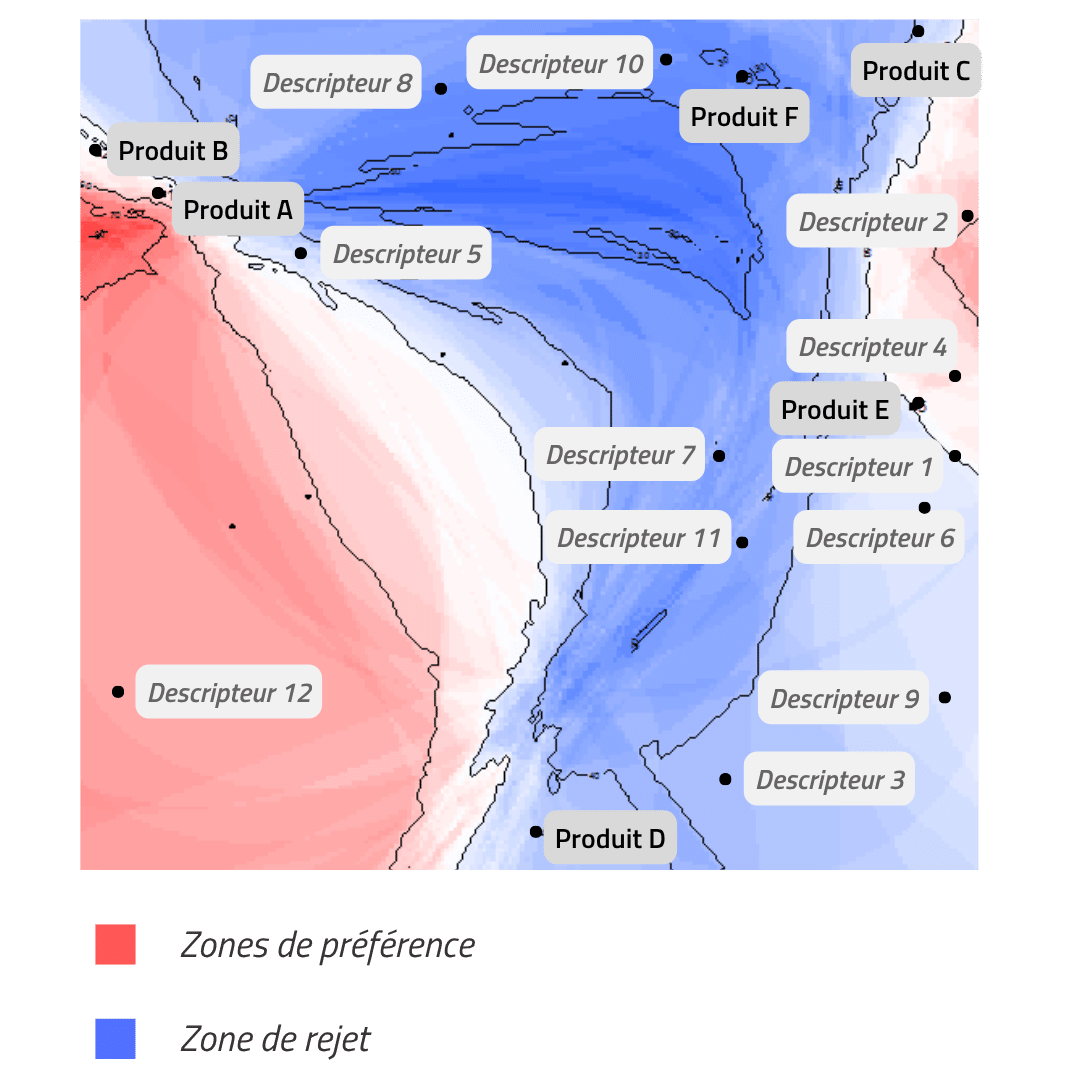
Sensory data and consumer ratings are cross-referenced to visualize product cluster positioning, as well as areas of preference and rejection. The results become clear.
Phase 4: interpretation
The goal here is to make sense of the areas under observation, to clarify the product’s positioning and guide future decisions. This is a crucial step.
Phase 5: strategic recommendations
Strategy, branding, design, communication. Concrete. Actionable.

A concrete example
Tools and techniques used
Preference mapping relies above all on complementary tools,selected with care. Nothing is left to chance. And that is essential.
1. It all starts with sensory and consumer tests : consumer panels or trained panels, hedonic evaluations, descriptive profiling. These methods make it possible to accurately measure perceived sensations—such as taste, texture, aroma, and appearance—that directly influence preference.
2. This data is then supplemented using both qualitative and quantitative methods : surveys, market research, behavioral analysis. These provide context and nuance, and help explain discrepancies in adoption rates. As you know, numbers alone don’t tell the whole story.
3. Finally, statistical analysis and mapping algorithms come into play. These algorithms cross-reference the data to generate a clear map, highlighting areas of preference and rejection, product positioning, and sensory descriptors that explain why certain products are more appealing than others.
Why choose Techni’Sens for your preference mapping?
Choosing a partner for preference mapping isn’t just about the tools. It’s primarily about method and detailed data analysis. And that changes everything.
At Techni’Sens, our expertise is built on a solid foundation: sensory analysis, a keen understanding of consumer preferences, and strategic marketing.. This combination allows us to go beyond mere observation. We don’t just say what people want to hear.. We’re trying to figure out why people like it and how to capitalize on it.
But keep in mind, the approach doesn’t stop at analysis. In fact, the analysis goes further. Through statistical analysis and by dissecting the models used to map consumer preferences, Techni’Sens is able to predict the characteristics of an ideal product, directly aligned with consumer expectations. It’s like a compass—a valuable one.
In practical terms, this makes it possible to optimize existing products, guide the development of new formulas, and even reduce costs through simulators that promote team autonomy and agility.
The result: a tailored, holistic approach designed to inform decision-making.
You have a product or service to test?
For your research
Our (other) solutions