


Techni’Sens’ solutions
Sensory analysis
Sensory analysis is a science dedicated to evaluating products using our senses. It plays a key role in sensory marketing and research and development, where consumers’ sensory perceptions are essential for creating memorable experiences and positively influencing their purchasing decisions. This approach makes it possible to decipher a product’s characteristics based on its description through taste, smell, sight, touch, and hearing.


What is sensory analysis?
Behind this somewhat technical term, the idea is actually quite simple: to describe and measure a product’s characteristics through the senses.
Sensory evaluation encompasses all methods used to analyze how a product is perceived through the senses: taste, smell, texture, touch, and appearance. In the food industry, these are referred to as organoleptic properties. In other sectors, such as cosmetics, the term “sensory characteristics” is more commonly used, but the approach remains the same: to objectively describe what is perceived.
Specifically, we measure:
- the perceived sensory characteristics of the product,
- the intensity and nuances of different products,
- the differences or similarities between formulations.
That’s not an opinion. It’s a fact.
The fundamentals of sensory evaluation
The insights gained from this method enable the identification of levers that directly influence purchasing decisions and consumer experience. By providing valuable data on the market, customer preferences, and expectations, it helps brands optimize their products to best meet these requirements and deliver quality products.
The methodology is defined by a thorough understanding of how humans perceive products. As this perception can vary significantly from one individual to another, sensory analysis is based on a principle of training to measure sensory stimuli in order to objectively evaluate a product’s properties. The levels of analysis encompass various aspects, ranging from simple identification to complex evaluation of sensations and their intensity.
The objectives of this assessment go beyond simply determining sensory characteristics; they also aim to ensure product quality. Through rigorous analysis, it is possible to identify targeted areas for improvement.
Why use sensory analysis?
Improving product quality
Thanks to descriptive evaluations and discriminative methods, it becomes possible to pinpoint exactly what works and what doesn’t. Too tart, not melt-in-the-mouth enough… every detail counts.
These analyses make it possible to:
- correct sensory imbalances,
- refine a formulation,
- ensure a product’s consistency over time.
Marketing decision support
Sensory evaluation provides concrete insights to guide decision-making: positioning, reformulation, and prioritization of development areas. It enables the transformation of sensory experiences into concrete decisions.
Ultimately, it helps to:
- reduce uncertainties,
- prioritize investments,
- maximize the chances of success in the market.
The sensory analysis process in practice
Selection of panelists
Careful selection of the consumer panel is a critical step in ensuring the validity of the results obtained during a sensory analysis. Techni’Sens maintains its own expert panel and assembles ad hoc panels tailored to the specific needs of each study.
Selection exercises were carried out by the volunteers (description test, rating scale test, ranking test, matching test) in order to assess their abilities:
- Ability to understand questions, answer a questionnaire, and express oneself, describe
- Ability to discriminate, learn, and memorize stimuli and differentiate intensities
Training for panelists
Training panelists is just as important as selecting them. It aims to refine their sensory skills, enabling them to conduct accurate and reliable evaluations. This process includes familiarizing them with the specific descriptors used to characterize the products being tested, as well as teaching them how to use rating scales based on defined minimum and maximum thresholds.
The effectiveness, consistency, and reliability of the results are directly linked to the quality of the consumer panel. Proper training not only ensures a better understanding of the subtle differences between products but also helps minimize inter-individual variations during evaluation sessions.
Sensory analysis methodology
The protocols and standards established by Techni’Sens play a key role in defining the right methodology to adopt for successful sensory analysis. Each step must be meticulously planned to ensure that the data collected is relevant and usable.
The analytical approach used in sensory analysis by a panel of experts aims to accurately and objectively measure the perceptions and feelings generated by the product.
The rigorous interpretation of data from this quantitative analysis, coupled with a focus on accuracy, enables companies to make informed decisions about developing or improving their products.
The implementation of sensory analysis makes it possible to:
- Determining whether there are sensory differences between products (discriminative methods)
- Objectively describe or compare products using descriptor analysis
Techni’Sens uses a variety of sensory evaluation methods tailored to the objectives set:
- Descriptive methods: QDA
- Time-based methods: TDS, TI, and TCATA
- Discriminative methods: triangular tests, 2/5 and Degree of Difference, are also used.
- As well as alternative methods such as free sorting, flash profiling, napping and free-linking

Examples of applications of sensory evaluation
Through sensory evaluations and descriptive and discriminative methods, it becomes possible to obtain an accurate and objective description of a product’s characteristics. This allows us to identify similarities and differences between prototypes, areas for improvement… and sometimes even untapped opportunities.
In practical terms, these methods make it possible to:
- to guide the formulation,
- to compare several prototypes with one another,
- to guide decisions based on measured product characteristics.
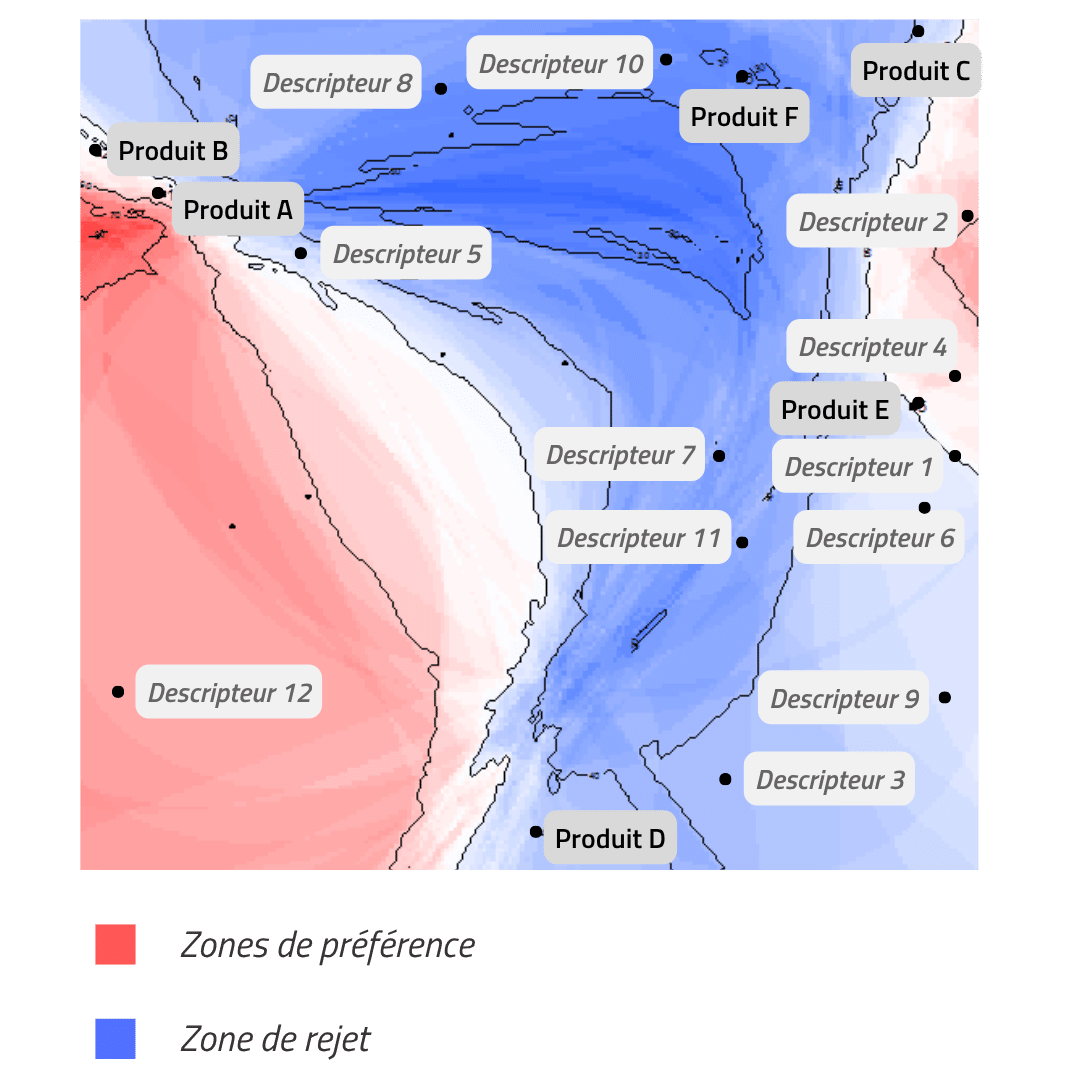
Focus on Preference Mapping
Techni’Sens uses a method called “Preference Mapping” to identify the sensory characteristics of an “ideal” product, in line with consumer preferences.
This approach links precise descriptive data (derived from profiles established by sensory experts) with hedonic data (consumer assessments).
The recommendations resulting from this analysis are strategic for optimizing the product under review, refining the brand’s positioning vis-à-vis the competition, and inspiring the development of new innovations.
Impact on product development
Sensory analysis is a powerful tool for understanding and improving how consumers perceive products. Techni’Sens, through its expertise and innovative methods, stands out in this field by offering high-quality services that help companies tailor their products and offerings to the expectations of their target audiences.
The methods used by Techni’Sens—such as descriptive analysis, temporal analysis, discriminant testing, and alternative approaches—enable a comprehensive and accurate assessment of a product’s sensory characteristics. The rigorous selection and training of expert evaluation panels ensure the reliability and consistency of the results obtained.
Future trends in sensory marketing promise to reshape the way we perceive products. By focusing on an enhanced user experience, they pave the way for a sustainable competitive advantage for brands that can innovate while addressing consumers’ deepest desires.
Would you like to conduct a sensory analysis?
For your research
Our (other) solutions